Nobody knows until they tried. Nobody knows but they have previous experience of a similar situation. Nobody knows but they have considered what’s the worst that can happen.
Nobody knows if you already tried once or a dozen times before and this time will be different.
But once you try you’ll know. You’ll know it works or doesn’t. It could work if only you adjusted or adapted.
A small group of us are in the city of Le Mans for the 24hr race. Same trains and apartment as last time. We hopped off the train and knew to keep the track on our right. A few minutes later we got to an unfamiliar junction. We realized our mistake. Although keeping the tracks to the right is a good idea, it turns out there is both a north and south exit. Therefore the tracks can be on our right going in both directions. It made me think of all the signals and little tricks we use to navigate life and can still go arwy. In order to have not got confused we should have chosen the additional variable. What else are we certain of that may turn out to be incorrect.
At a time when the creative industries are being revolutionised by digital transformation, shifting audience dynamics, and evolving funding landscapes, we’ve captured a powerful snapshot of leadership thinking that cuts through the noise.
One of the key things for improving over the long term is ensuring people are heard. In https://www.sociocracyforall.org/ there are a number of ways this is done. You can read those yourself. Being heard isn’t the same though as having to do whatever you are told in that feedback. It is too simplistic to assume having every voice heard means everyone gets a say. It is ok to say “I hear you but on this occasion I’m going in a different direction but thanks for your feedback it did help me make a decision.”
Last night, the Administration issued a new Executive Order aimed at gutting the Institute of Museum and Library Services (IMLS). Eliminating the only federal agency dedicated to supporting museums directly undermines the will of the people (96% of whom want to see federal funding maintained or increased for museums) and the critical roles museums and museum workers play in American society.
We want to be successful. One of the aims to achieve success is to know our individual fans/users/customers better. Knowing their needs allows us to design and run better services. A good service is an effective service. From the many anonymous interactions we have every day, we want to shine light on those touchpoints to know as many of them as we can.
Instead of just using generic terms like “total visitors to site (online and in-person), website visits per quarter, google review score, Spend per head etc there is an opportunity to be better informed. With better insights we can make data-informed decisions that don’t treat everyone identically the same. Kevin Kelly wrote about the benefits of having 1000 true fans which in summary says within any large group of people are die hard fans who give you momentum (MVP adjacent).
Find them by building services that allow you to identify who they are across your services (opt-in of course). Use their data test assumptions about how our worldviews collide. Spot something that doesn’t work and fix it. Fix it for the fans and you’ll probably be fixing it for everyone.
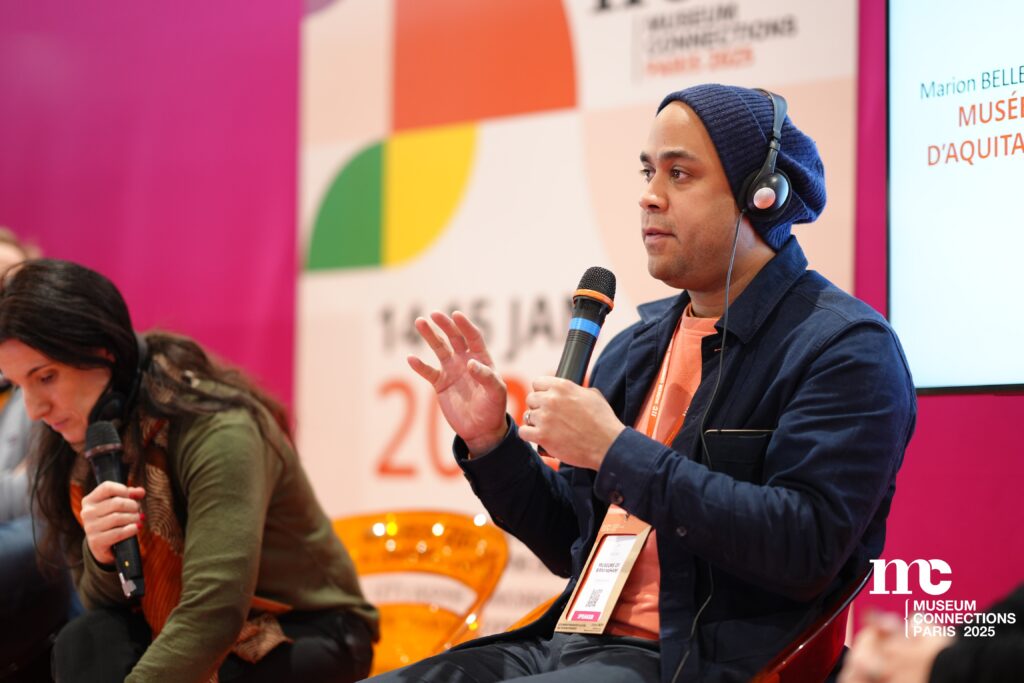
Firstly, thanks to the good folks at Museum Connections for the invitation. I joined a great panel and 150 attendees to discuss how we’re trying to close the particapation gap at Birmingham Museums Trust. The headphones in the above photo were for the live translation not for the vibes!
My whole career to date has been about “helpful to people” so the focusing on those who visit vs those who don’t is a topic close to my heart.
Below is a mix of my thoughts and notes for the session. Hat tip to Sara and Mark O’Neill for their thoughts on the session in advance.
Inclusion, Solidarity: Welcoming people living in poverty
Over the past few years, the social role of cultural institutions has continued to evolve, adapting to contemporary challenges. Despite increasing pressure to generate revenue, cultural venues are redefining their social and solidarity efforts to meet current needs, moving beyond free admission alone. This panel discussion explores studies examining the real barriers that prevent people in precarious situations from visiting cultural institutions. We will focus on the role of these institutions in supporting ambitious, long-term inclusion programs and their funding. Additionally, we will address how cultural venues can raise awareness and advocate against exclusion, both internally and externally.
Marion Belleville (France)
Sarah Hugounenq (moderator)
Zak (me!)
Clement LaLot (Belguim)
Leanne Wickham( New Zealand)
Who’s it for?
BMT runs 9 sites in Birmingham, UK which is in the middle of the country with only London having larger population. Population of 1.1m with 6m people in the region.
We reach up to 1m visitors per year at our physical sites plus several million online AND up to 10m via objects on loan around the world. Birmingham is nearly 50% people of colour and has a young population.
The City Council has gone bankrupt (s114) and we are operating within the impact ofthe deepest financial crisis.
What’s it for?
Culture is a basic human right and therefore should be universal. We think Museum audiences should be broadly representative of society. If we have barriers then we are failing people.
In the book Culture is Bad for you, they focus on failings over 40 years between both the creation and consumption of culture and how this highlights the inequality.
Survey data on who visits museums and decades of research in cultural sociology internationally tell us that museum visiting reflects the socio-economic gradient, closely tracking inequalities in education, income, employment, mental health and other indicators of social wellbeing. Despite the scale of existing evidence, including evidence that the attendance and benefit gap may be increasing, government policy, professional guidance and research undertaken by museums themselves continue with little or no recognition of this wider context and macro data and, as a result, have failed to develop sustainable evidence-based solutions to address inequalities in museum attendance and benefit.
This Network explores the hypothesis that a deeper understanding within museums and museology of (1) the nature and experience of inequality and (2) how large-scale social and behaviour change is approached in other fields, such as health, would open up the capacity in museums and amongst museum scholars to understand, theorise, design, implement, evaluate and sustain practices which may address the attendance and benefit gap.
Together we are asking:
How can we better understand who visits and benefits from museums?
What can existing population-level and museum data tell us about those who visit and those who do not?
What research can museums committed to representative participation draw on to understand audience development more strategically?
How might museums utilise research and strategies from fields such as implementation science to drive evidence-based decision making, understand which changes in museums successfully broaden visitor demographics and sustain progress towards representative participation?
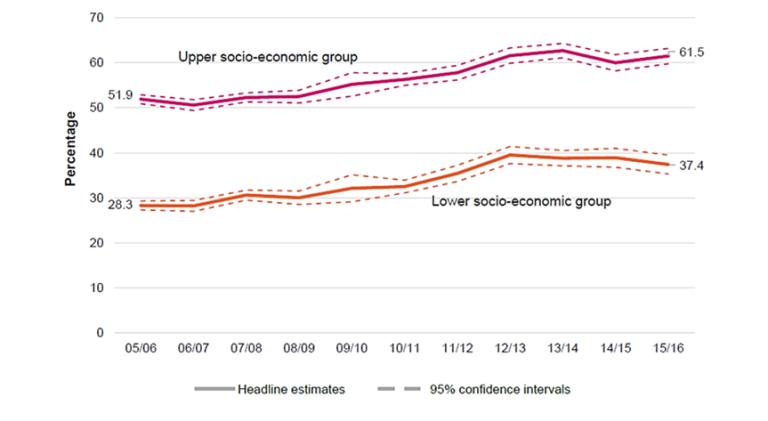
Our Museum visiting reflects the socio-economic gradient, closely tracking inequalities in education, income, employment, mental health and other indicators of social wellbeing.
The graph shows a gap of approx 25% between cohorts. Change is needed at “population level change” as small interventions don’t move the needle enough.
BMT has 9 sites. We oeprate both free and charging yet the types of people who visit are the same for both FREE and paid which shows that chargign isn’t the barrier in the way we often think it is.
Mark O’Neill, a key collaborator says: Museums that are interested in increasing access create more accessible displays, using Universal Design principles and storytelling. They increase the representation of the culture and heritage of previously excluded groups and above all they create a welcoming atmosphere for novice visitors and their families. They also have a range of engagement programmes, involving activities under headings like Wellbeing, creativity, social inclusion and social mobility. CO-production, greatly inspired by Nina Simon’s book on the Participatory Museum is often seen as the key to radically improved inclusion.
As an aside the book Universal Design Principles was a key text for me when I was studying Computing and a copy still sits by my desk!
Barriers (for focus on this panel)
Focused onthe already well educated and neglecting those who may most benefit
the single most important predictor of museum visiting is not class, ethnicity or income but level of prior educational achievement.
Relevance – 80%+ of Citizen Jury started off by saying museums were not for them
require population level change
projects don’t stick or scale – too small
economic and educational disadvantage
Creation AND consumption of culture need to be considered not just consumption
Opportunities
The Network will test the assumption that if museums understand the extent to which the attendance and benefit gap is driven by societal factors, they may be able to develop interventions which are most likely to have an impact.
being People centred
critical to be data-informed – but sector needs to undersand how to use data better)
[Example] of staff wearing own clothes which leads some people to see themselves ((affiliation))
Deeper understanding of how museums need to change to be relevant and appealing to people with no/low educational qualifications
Redirect engagement resources to transforming the museum as a whole – key concept
From Nina Simon, Chapter 5, Desire for the input and involvement of outside participants, Trust in participants’ abilities and Responsiveness to participants’ actions and contributions
Library example
Libraries promote literacy through provision of books and support.